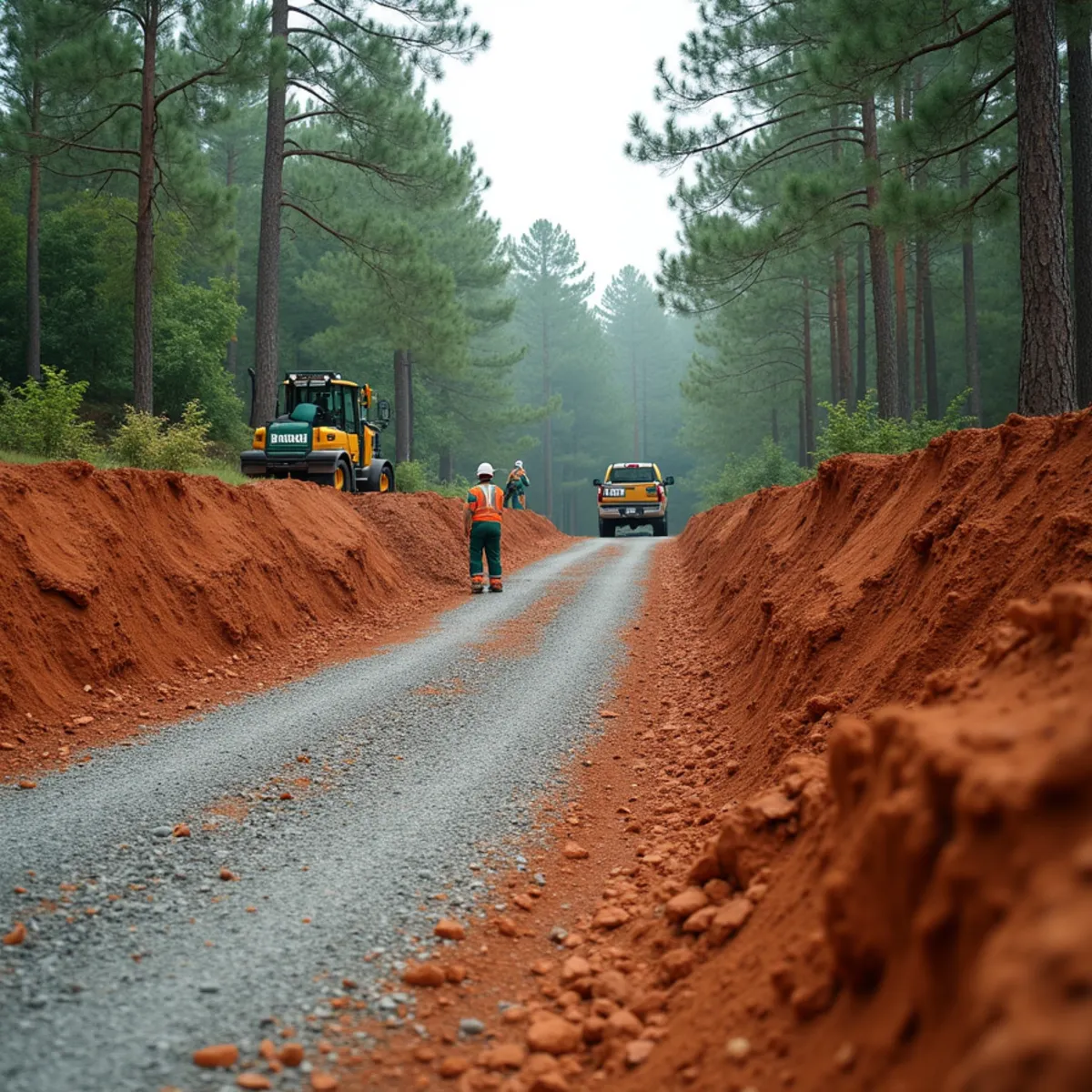
A sloped driveway in Central Alabama can look perfect on Friday and be gutted by rutted channels on Saturday morning. All it takes is one of the region's heavy downpours hitting a grade that concentrates water into a single path. Gravel migrates to the bottom, dirt drives develop deep gullies, and even concrete and pavers can undermine when water scours the soil beneath their edges.
Repairing a washout is straightforward if you only want it to look fixed. Repairing it so it stays fixed requires understanding why the water carved that path in the first place. This guide covers both the immediate repair and the slope stabilization that keeps the next storm from repeating the damage across Prattville, Millbrook, and the wider River Region.
Read the Washout Before You Fill It
Every washout is a map of where the water went. Before you haul in a single load of gravel, walk the driveway and trace the channels. Notice where water entered the drive, where it gained speed, and where it exited. Almost always you will find that runoff from an upslope area, a roof, a hillside, or the road, funneled onto the driveway and had nowhere else to go.
If you simply refill the ruts without addressing that concentration of water, the next rain will carve them again in the same place. The repair and the diversion have to happen together.
Immediate Stabilization After the Storm
Once the rain stops and the surface is safe to work, a few steps limit further damage and restore access:
- Clear debris and displaced gravel from the low end so water is not dammed on the driveway.
- Fill deep gullies temporarily with compactable crushed stone rather than loose pea gravel, which simply washes away again.
- Cut a temporary diversion at the top of the drive to steer incoming runoff off to the side.
- Protect any undermined edges of concrete or pavers by supporting the soil beneath them until a proper repair.
- Photograph the damage in case erosion has affected a shared drive or a neighbor's property.
These moves get you back in and out and stop active erosion, but they are not the cure. On our heavy clay, loose fill without compaction and without water control is temporary by nature.
The Real Cause: Uncontrolled Slope Runoff
The core issue on a washed-out driveway is almost always volume and velocity of water. Water gains destructive energy as it moves downhill and as it concentrates into a narrow path. The permanent fix reduces both: it intercepts runoff before it reaches the drive, spreads it out, and slows it down.
Our emergency drainage washout repair crews approach this in layers. First, we intercept upslope water with a swale or a drain so it never loads onto the driving surface. Second, we rebuild the driveway base with properly compacted, angular stone that locks together and resists migration. Third, where the slope alongside the drive is steep and unstable, we may build a retaining structure to hold it.
Retaining Walls Where the Grade Is Severe
On the steepest lots, the ground beside a driveway keeps sliding no matter how well the surface is repaired. That is where our concrete retaining wall block construction earns its place. A properly engineered wall, built with drainage behind it and a compacted base beneath it, holds the slope in position and takes the lateral pressure off the driveway edge. Walls that fail almost always fail because water was not managed behind them, which is why we build drainage into every wall from the start.
Regrading and Crowning the Surface
A driveway should shed water to its sides, not carry it down its center. Crowning the surface, so it is slightly higher in the middle, and shaping shallow shoulder ditches gives the water an early exit. Combined with compacted base stone, a crowned drive can take a hard rain without gullying.
Why Compaction Matters More Than Material
Homeowners often assume the fix is simply more gravel. In reality, the difference between a driveway that lasts and one that washes again is compaction and the right stone. Angular crushed stone, placed in lifts and mechanically compacted, forms an interlocked layer that water struggles to move. Rounded river gravel dumped loose will always find its way downhill. The base is the part you cannot see and the part that determines everything.
Stabilize the Slope, Not Just the Surface
A washed-out driveway is your property telling you where the water goes. Fill the ruts if you must to get through the week, but the lasting repair intercepts the runoff, rebuilds the base correctly, and holds the slope with proper structure. Truvian Lawn Care handles emergency washout repair, drainage, and retaining walls across Prattville, Millbrook, and the River Region. Call (323) 606-0255 and we will help you fix it once, correctly.
Related from Truvian Lawn Care