
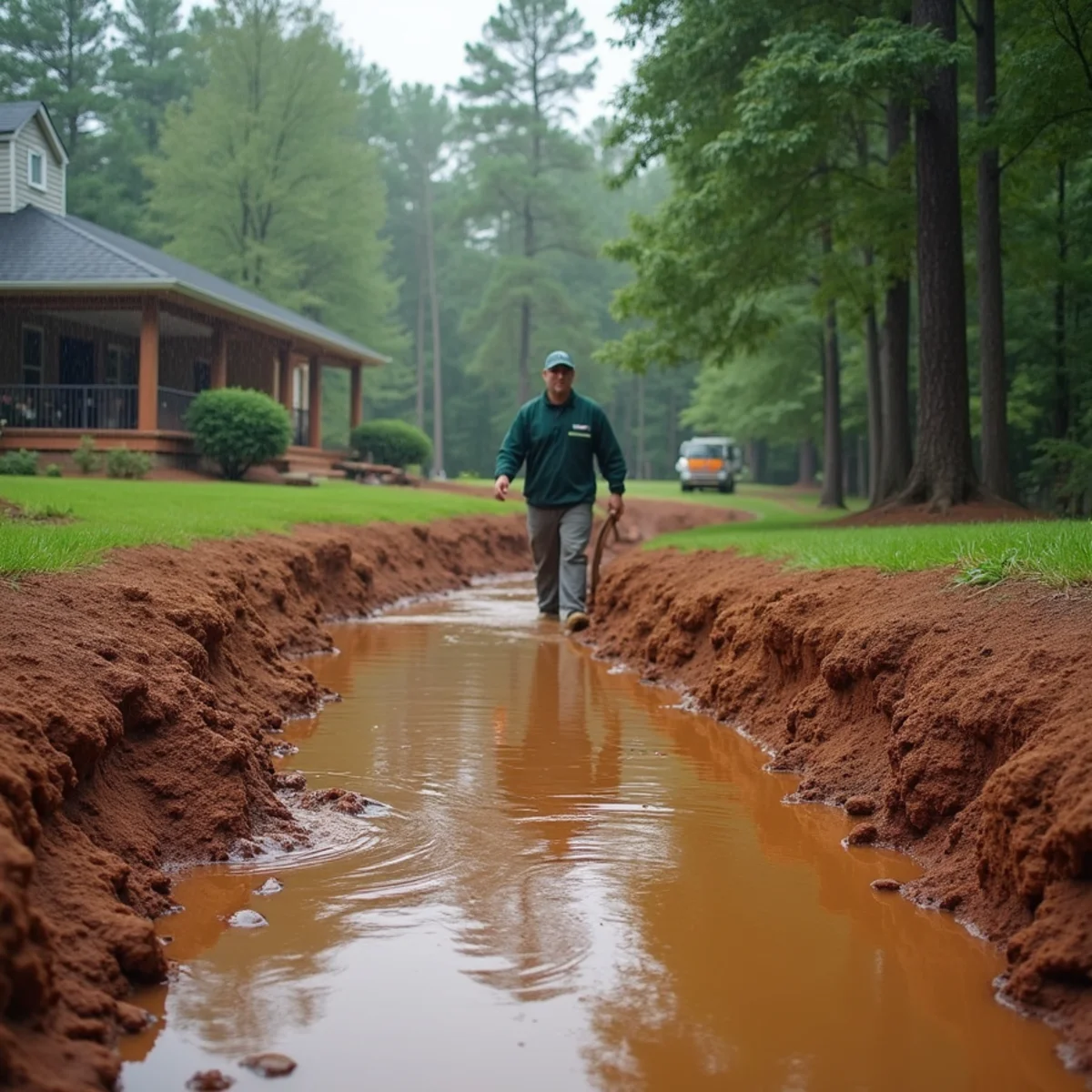
Central Alabama averages more than fifty-four inches of rain a year, and much of it arrives in heavy bursts that the region's dense red clay simply cannot absorb fast enough. When a storm dumps two or three inches in an afternoon, that water has to go somewhere, and on a poorly graded lot it goes toward the lowest point it can find, which is often the base of your house.
Water standing against a foundation is not a cosmetic problem. Given hours, it works into footings, saturates crawl spaces, and finds hairline cracks. Given years, repeated saturation is one of the leading causes of foundation movement in the River Region. This guide covers the emergency moves that buy you time during an active flood, and the permanent drainage that keeps it from happening again.
Why Red Clay Makes Flooding Worse
Sandy soils drink water down through their pores. Red clay does the opposite. Its particles are tiny and pack tightly, so once the top inch is saturated, additional rain sheets across the surface instead of soaking in. Homeowners in Deatsville and Wetumpka often see this as a yard that is bone dry an inch down yet has water running across it like a parking lot.
That surface runoff is predictable, which is the good news. If you understand where the water wants to travel, you can intercept it and send it somewhere harmless. During an emergency, that interception is done with a shallow diversion trench. Afterward, it should be done properly with buried drainage.
Immediate Steps During an Active Flood
If water is actively pooling against your home right now, your priority is to break its path to the foundation and give it a downhill escape. Work only where it is safe; never enter moving water, and stay away from any submerged electrical equipment.
- Find the high side of the pooling water and the nearest downhill outlet, such as a ditch, swale, or the street.
- Cut a shallow diversion trench across the water's path, angled to carry it away from the house toward that outlet.
- Clear every downspout extension and roof drain; a single clogged gutter can dump hundreds of gallons at the foundation.
- Use sandbags, boards, or even rolled soil as a temporary berm to steer water into your trench.
- Pump standing water out of window wells and low crawl-space vents if you have a safe way to do so.
A trench does not need to be deep to work. Even a few inches, cut on a downhill grade, will redirect surface sheet flow because red clay refuses to let the water sink. The point is to give the water an easier path than the one leading to your house.
What Not to Do in the Panic
In the rush, homeowners often make the problem worse. Do not pile mulch or soil against the foundation hoping to block water; you can trap it there instead. Do not send your diversion trench toward a neighbor's lower property, which creates a dispute and possibly a liability. And do not assume the water will simply drain once the rain stops, because clay holds it for days.
The Permanent Fix: Engineered Drainage
Emergency trenches are a bandage. Once the storm passes, the real solution is to intercept water before it ever reaches the house and carry it underground to a safe outlet. On red clay lots, that usually means a combination of regrading, buried downspout lines, and a properly bedded drainage system.
Our french drain and catch basin systems are built for exactly this soil. A french drain is a gravel-bedded perforated pipe wrapped in filter fabric that collects subsurface and low-lying water; catch basins capture the surface pooling at known low spots. Together they turn an unpredictable flood path into a managed one. For yards that flood repeatedly, our emergency yard flood and water mitigation service can respond during the event and then design the permanent system afterward.
Grading Comes First
Before any pipe goes in, the ground around the foundation should slope away from the house, ideally dropping several inches over the first several feet. On many older Elmore County lots the grade has settled flat or even back toward the home. Correcting that slope is often the highest-impact, lowest-cost part of the whole fix.
Then the Water Gets a Home
Once the surface is shaped, buried lines carry roof water and collected runoff to a daylight outlet, a dry well, or the street. The difference this makes on clay is dramatic: the same storm that used to pond against the foundation now runs quietly out to the ditch.
Protect Your Foundation Before the Next Storm
Red clay flooding is a River Region fact of life, but a flooded foundation does not have to be. Handle the emergency safely with quick diversion, then invest in drainage that ends the cycle for good. Truvian Lawn Care designs and installs french drains, catch basins, and regrading throughout Deatsville, Wetumpka, and the surrounding area, and we respond to active flooding around the clock. Call (323) 606-0255 and let us keep the water where it belongs.
Related from Truvian Lawn Care