There is a particular kind of lawn frustration common across Deatsville and Prattville: days after the rain has stopped, whole sections of yard are still spongy, squishy underfoot, and dotted with puddles that refuse to drain. The grass in those areas thins, turns yellow, and eventually gives way to moss or bare mud. The cause is almost always the same: heavy red clay that holds water like a bathtub.
You cannot change your soil type, but you can give the trapped water somewhere to go. French drains and buried downspout lines are the two workhorses of red clay drainage, and used together they can transform a chronically soggy lawn into one that dries out and grows healthy turf. Here is how they work and when each one is the answer.
Why Red Clay Lawns Stay Wet
Water moves through soil by traveling between soil particles. In sandy soil the particles are large and the gaps are wide, so water drains quickly. Red clay particles are microscopically small and pack together tightly, leaving almost no room for water to pass. The result is soil that both sheds surface water and, once wet, holds onto it for a very long time.
For a lawn, staying waterlogged is a slow death. Roots need oxygen, and saturated soil suffocates them. Constant moisture also fuels the fungal diseases that thrive in Alabama's humid climate. A lawn that never dries out cannot be fixed with more fertilizer or reseeding; it has to be drained.
What a French Drain Actually Is
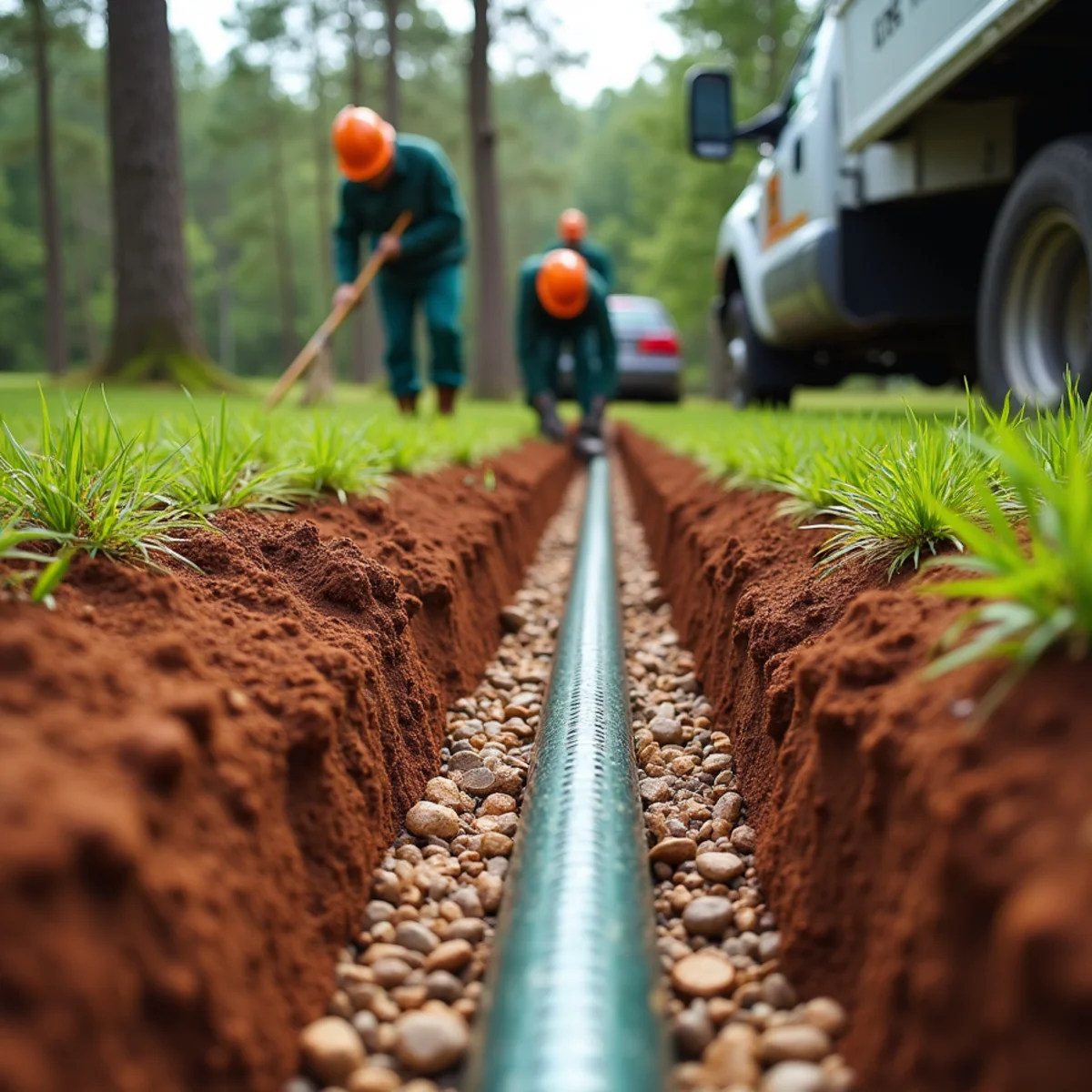
A french drain is often misunderstood. It is not just a ditch. A proper french drain is a trench dug on a slight downhill grade, lined with filter fabric, filled with clean angular gravel, and containing a perforated pipe near the bottom. Water in the surrounding soil, and water that collects on the surface at a low point, seeps into the gravel, enters the perforated pipe, and is carried away to a safe outlet.
The filter fabric is critical in clay. It lets water pass while keeping the fine clay particles out of the gravel and pipe. Without it, clay migrates in and clogs the drain within a season. Our french drain and catch basin systems are built with quality fabric and clean stone precisely so they keep working for years, not months.
Grade Is the Whole Game
A french drain only works if it runs continuously downhill to a lower outlet. Even a small reverse slope will leave water sitting in the pipe. Establishing and holding that grade over the length of the trench is the part that separates a drain that works from one that does nothing, and it is where careful installation matters most.
Burying the Downspouts
Here is a number that surprises homeowners: a single inch of rain on a modest roof sheds hundreds of gallons of water, and every gutter dumps that flood right at the foundation unless it is carried away. Downspout extensions lying on top of the ground get moved, mowed over, and never reach far enough. Burying the downspout lines solves it permanently.
We connect the gutters to buried solid pipe that carries roof water well away from the house to a daylight outlet, a pop-up emitter, or a drainage system. This single step often resolves the worst of a soggy-yard problem, because roof water is frequently the largest single source of the flooding. It also protects the foundation, a topic we cover in our emergency yard flood mitigation guidance.
Matching the Fix to the Problem
Not every wet lawn needs the same solution, and part of doing this right is diagnosing before digging:
- Puddles at the base of downspouts point to roof water; bury the downspout lines first.
- A soggy low area that collects runoff calls for a catch basin feeding a drain line.
- A broad area that stays saturated after rain benefits from a french drain to lower the water in the soil.
- Water sheeting toward the house needs regrading combined with interception.
- Most real yards need a combination, designed as one connected system.
Where Does the Water Go?
A drainage system is only as good as its outlet. The collected water has to reach somewhere lower and safe: a ditch, a swale, the street, or a dry well sized for the volume. Part of designing a system for a River Region lot is identifying that outlet and, when the lot is flat, engineering a way to reach it. This is exactly the kind of judgment that a site visit provides and an online video cannot.
Give Your Lawn Somewhere to Drain
A waterlogged red clay lawn is not a lost cause; it is a drainage problem waiting for a solution. French drains lower the water trapped in the soil, buried downspouts remove the roof water that causes so much of the flooding, and together they let your turf finally dry out and thrive. Truvian Lawn Care designs and installs drainage systems built for Alabama clay across Deatsville, Prattville, and the River Region. Call (323) 606-0255 for an assessment of your soggy spots.
Related from Truvian Lawn Care